
Confused by the bread aisle? Follow our 5-step guide to choosing the healthiest bread. Learn to spot hidden sugars, decode labels, and find the best whole grains for your heart and gut.
Standing in the bread aisle can feel overwhelming. With dozens of labels shouting about “whole grains,” “keto-friendly,” and “no artifical colors or preservatives,” it’s hard to know what’s actually going into your cart.
The truth is, there is no single “perfect” loaf. Different breads offer different benefits depending on your lifestyle and taste preferences. However, by knowing what to look for on the label, you can choose a bread that supports your heart, gut and energy levels. Follow these five steps to master the bread aisle like a pro.
1. Master the Label (Beyond the Calories)
Don’t get stuck on the calorie count alone. According to the United States Food and Drug Administration (FDA) standards, 100 kcal is considered moderate for a serving of bread. If a slice is slightly higher in calories but packed with fiber and protein, it could be better choice for staying full.
- Check Serving Sizes: Some brands list one slice as a serving, while others list two. Make sure you’re comparing apples to apples!
- Watch the Sodium: The American Heart Association (AHA) recommends capping sodium at 2,300 mg per day. Check the label to ensure your bread isn’t a hidden source of salt.
- Scan for Fat: AHA also recommends a limit of 13 grams of saturated fat a day and avoiding trans fat. This applies to what you put in your sandwich as well!
2. Decode the Ingredient List
Ingredients are listed from greatest to lowest quantity. If the first ingredient isn’t a grain, put it back. In this section you can check if your bread has food additives, added sugar and salt. In some cases ingredients like salt can be shown as sodium benzoate or monosodium glutamate (MSG).
3. Spot the Hidden Sugars
Bread only needs a few basics: flour, water and a leavening agent. However, sugar is often added to enhance flavor or shelf-life. If sugar (or any of its aliases like high fructose corn syrup, maltodextrin or rice syrup) is one of the first three ingredients, it’s more of a treat than a staple.
4. Prioritize Whole Grains
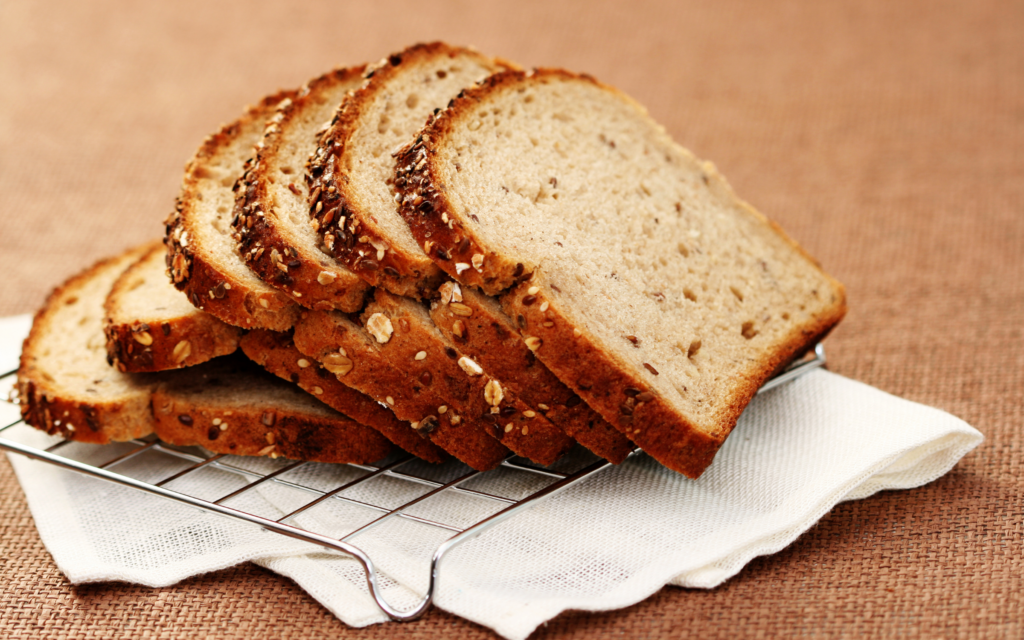
The word “Multigrain” sounds healthy, but it often just means the bread contains several types of grains. Instead, look for the word “whole” in the list of ingredients after the cereal to which it refers (e.g., whole wheat). You can also identify whole grain breads with the “Whole Grain Stamp” developed by the Whole Grain Council.
Whole grains protect the heart, reduce the risk of chronic diseases, improve intestinal microbiota and help maintain ideal body weight. They are rich in dietary fiber, minerals and vitamins.
5. Get Focused on Fiber
Look for breads that offer at least 3-5 grams on fiber per serving (and high-fiber breads contain at least 5 grams of fiber per serving). Dietary fiber such as wheat bran improves digestion and reduces the risk of colorectal cancer, obesity and heart disease.
Some breads also contain added fiber such as inulin, a natural plant soluble fiber that acts as a powerful prebiotic, which is beneficial in feeding the “good” bacteria in your gut.
The Enriched & Fortified Advantage
Don’t forget that “healthiest” can also mean “most nutrient-dense.” Enriched and fortified grain foods contain folic acid, iron and B vitamins, nutrients many Americans don’t get enough of. If you aren’t getting these from other sources, an enriched bread can provide vital nutritional benefits.
Choosing the healthiest bread is about finding the balance between fiber, fortification (or enrichment) and flavor. By prioritizing whole grains and keeping an eye on added sugars and salt, your daily sandwich can become a cornerstone of a healthy, balanced diet.